
Journal · Sonic branding
Sonic branding in retail: how stores use sound to sell
Walk into most stores and the music is chosen the way a hotel chooses its lobby scent - broadly pleasant, vaguely on-brand, and gone from memory the second you leave. That is not sonic branding. Sonic branding in retail is the deliberate design of everything a store sounds like: the tone that greets you at the door, the logic behind the playlist, the chime at the till - built to be recognizable with your eyes closed, the same way a logo is recognizable at a glance. Here is what that actually looks like, and where most retailers stop short of it.
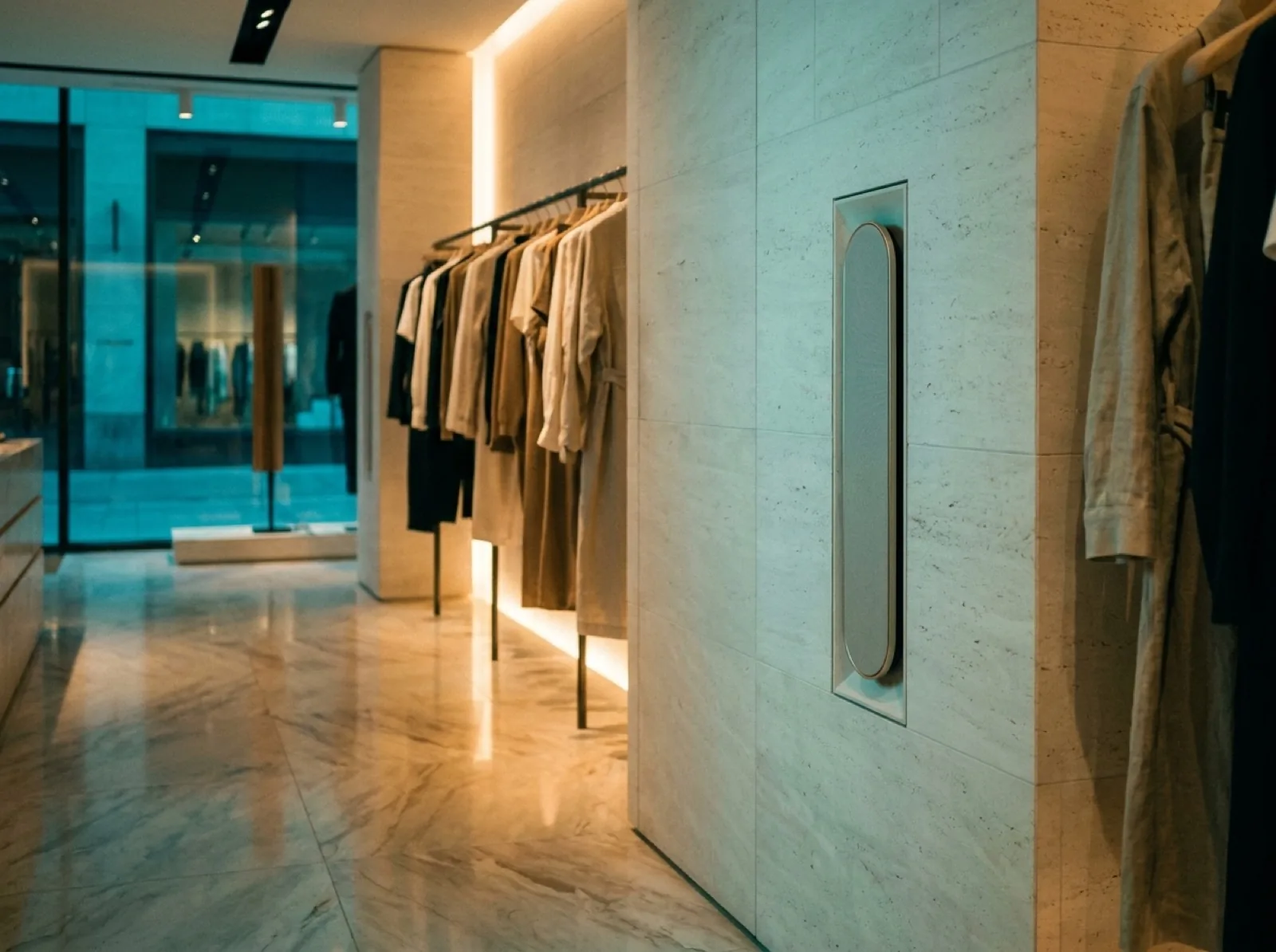
Why retail cares about sound
Sound reaches a shopper before a single product does. It shapes dwell time - how long someone lingers rather than glancing and leaving - and dwell time is one of the few variables retail has always known correlates with spend-per-visit. It shapes recall, too: a customer forgets most of what a store looked like within a day, but a sound repeated consistently across visits builds the kind of recognition a logo takes years to earn. Most retailers already know this intuitively - anyone who has felt a shop go from inviting to unbearable the moment the music turned wrong has run the experiment once, on themselves. What is less appreciated is how thoroughly the research backs it up.
What changes when a brand takes this seriously is not whether to have sound - every store already does, by accident if not by design - but whether that sound is doing any work for the brand, or simply filling silence.
What the research actually shows
The link between in-store sound and shopper behavior is one of the more studied corners of retail psychology, and a few findings surface again and again. In a widely cited 1982 supermarket study published in the Journal of Marketing, the researcher Ronald Milliman found that slower-tempo background music slowed shoppers' pace through the aisles and was associated with a notable lift in sales volume compared with fast-tempo music - the tempo of the music quite literally set the tempo of the shop. A companion 1986 study in restaurants found the same lever at work on dwell time: slower music kept diners at the table longer and raised bar spend. And in a 1997 study published in Nature, Adrian North and colleagues showed that playing French or German music in a supermarket's wine section measurably shifted purchases toward wine from the matching country - with most shoppers never realizing the music had steered them at all.
The exact figures vary by study, and none of this is a formula: a slow playlist will not rescue a badly merchandised store, and no piece of research licenses the claim that sound alone drives sales. But the direction is consistent and decades deep - sound changes how long people stay, how fast they move, and, at the margin, what they reach for. For a brand, that is the whole difference between music treated as wallpaper and music treated as a designed variable.
What sonic branding actually looks like in a store
Strip it down to components and a real retail sonic identity is built from a handful of distinct layers, each doing a different job.
The sound logo
A short audio signature - at the door, on the app, at checkout - functioning exactly like a visual logo except it arrives through the ear instead of the eye. Two or three seconds, repeatable, and unmistakably the brand's own rather than a stock chime shared with a hundred other apps.
In-store playlist logic
Not a mood, a system: a music policy tied to time of day, footfall, and season, built around a defined tempo and instrumentation range so that every store - and every shift - sounds like the same brand rather than whatever the staff queued that morning. This is the layer most retailers already spend money on and still get wrong, because a playlist without a written brief is just someone's taste standing in for a strategy.
Transition and confirmation tones
The small sounds a store makes back at the customer - a till confirmation, a fitting-room door, a loyalty-app scan. Generic devices ship with generic beeps; a designed identity replaces them with tones pitched and voiced to match everything else the brand sounds like, so the whole experience feels like one instrument rather than several appliances.
What separates this from background music is intent and repetition. Background music sets a mood for an afternoon. A sonic identity is composed or curated to a brief, repeats consistently enough to be learned, and is designed to survive the sound being turned off entirely - because a real identity should be describable in words, not just felt in the room.
The examples everyone cites - and what they miss
Search this subject and you will meet the same short list every time: McDonald's "I'm lovin' it," the Intel bong, the Mastercard sonic logo, the Apple startup chime. They get cited so often because they are genuinely good - each one is distinctive, owned, and recognizable in under two seconds. But notice what they mostly are: sound logos - a short signature that plays in ads and at a payment terminal - rather than a full in-store identity. That is the gap most retail-sound coverage quietly steps over. A memorable payment chime is one touchpoint; a store that sounds like the brand from the door to the fitting room to the till is a system. The famous examples prove sound can be owned and remembered. They do not, on their own, show you what a coherent retail identity feels like end to end - which is exactly the part worth designing, and the part a shared streaming playlist can never deliver.
The luxury-retail case: Jacquemus
Jacquemus is the clearest proof point this studio can point to for what disciplined, brand-specific sound design does at the top of the retail market, even though the commission itself was a fashion film rather than an in-store install: scored for the Institut Français de la Mode showcase, the piece carries an entire emotional arc - boredom, longing, the thrill of a day about to begin - with no dialogue at all. The same restraint that makes that score work is exactly what a Jacquemus boutique needs from its in-store sound: nothing that competes with the clothes, everything built from the house's own register rather than a licensed mood. The brief changes from a three-minute film to a looping in-store system, but the DNA the sound has to carry does not.
That is the throughline worth taking from luxury retail generally: the houses that treat sound as identity - reserving it the same craft as a boutique's lighting or scent - are building an asset. The ones that leave it to a shared streaming playlist are borrowing someone else's, one that any competitor can borrow just as easily.
Retail vs. hospitality vs. luxury: why the brief changes by category
The same principles apply across categories, but the brief itself moves - mostly along one axis: how long the customer stays, and how much restraint the brand demands. A high-footfall chain, a hotel lobby, and a luxury boutique are solving three different problems with the same tool.
| Category | Primary goal | Dwell time | Sound character |
|---|---|---|---|
| High-street retail | Consistency across many locations; move shoppers through | Short | Energetic and self-running, tightly briefed so every store matches |
| Hospitality | Keep guests comfortable and in place | Long | Slower and warmer, paced to extend the stay |
| Luxury retail | Signal scarcity and craft; protect exclusivity | Variable | Quieter, fewer touchpoints, exclusively owned |
Each category is its own brief, which is why a hospitality sonic identity is its own subject, worth its own piece rather than a paragraph here - covered in full in sonic branding in hospitality - and beauty retail bends the brief further still, since most of its exposure now happens on a phone screen before a customer ever reaches a counter, covered in sonic branding for beauty brands. What holds across all three is the underlying discipline: the sound is designed to a goal, not defaulted to a playlist.
What a retail sonic identity costs and how it's built
Pricing follows the same logic as any sonic branding project: scoped to touchpoints, not sold off a rate card. A single entry sound logo is a smaller commission than a full system covering entry, playlist logic, and till tones across every location - the difference is real work, not markup. For the full tier-by-tier breakdown of what drives the number, see what does sonic branding cost. The build process itself follows the same steps as any commissioned identity - brand analysis, a composed or curated core idea, testing at the scale the brand actually needs - covered in full in the sonic branding service overview.
Common mistakes
Two mistakes account for most retail sound that fails to become an identity. The first is mistaking licensed background music for a sonic identity - a curated streaming playlist can sound pleasant in the room and still do nothing for recognition, because it belongs to the platform's mood, not the brand's. The second is a missing through-line: a store that sounds one way in person and completely different in its ads and social content is not building recognition, it is running two disconnected campaigns that happen to share a logo. A sonic identity only compounds if the same signature shows up everywhere the brand does - in the store, in the film, in the fifteen-second cutdown - not just in the one room it was designed for.
How to audit your store's sound in an afternoon
Before commissioning anything, any brand can diagnose its own retail sound for the cost of an afternoon and some honesty. Stand in the doorway and listen: is there a sound that marks arrival, or does the store simply leak whatever happens to be playing? Walk the floor with an ear on the playlist: does the music hold one tempo and character, or lurch between moods depending on who queued it that morning? Listen to the machines: the till, the card terminal, the door chime - are those sounds designed, or factory defaults shared with every other shop on the street? Play your ads back to back with a recording of the store: would a customer know they came from the same brand with their eyes shut? Visit two competitors and repeat the test: in most categories you will find everyone drawing from the same three moods, which means distinctiveness is sitting there unclaimed. The gap list that comes out of that hour is your brief - and in my experience it is rarely longer than a page, which is exactly why the fix is more attainable than most brands assume.
Frequently asked questions
What is sonic branding in retail?
It is the deliberate use of sound inside a physical store - a sound logo at entry, considered playlist logic, transition and confirmation tones, even the acoustic quality of a door or till - so the space sounds as designed as it looks. It is different from playing background music, which borrows a mood rather than building one that belongs to the brand.
Does music tempo affect sales in retail?
The research suggests it affects behavior, which is not quite the same as guaranteeing sales. In a widely cited supermarket study, slower-tempo music slowed shoppers' pace and was linked to higher sales volume than fast-tempo music; in restaurants, slower music extended dwell time and raised bar spend. Tempo is a real lever, but it works alongside good merchandising, not instead of it.
Does in-store music count as sonic branding?
Only if it is chosen deliberately and consistently enough to become recognizable as the brand's own. A generic curated playlist sets a mood for the afternoon; a real retail sonic identity is composed or curated to a brief, repeats across every location, and is built to be identifiable with the sound off - a distinction most stores never actually make.
How much does a retail sonic identity cost?
It depends on scope - a single entry sound logo is a different project from a full system with playlist logic, transition tones, and guidelines for every store. For the full tier-by-tier breakdown of what drives the price, see what does sonic branding cost.